
Put your history into words a doctor will hear.
You already know what your body does. The problem is a seven-minute appointment, and a description that gets waved off as normal.
Eight questions, about two minutes. You'll get back a one-page summary of your own history written in clinical language, the tests worth asking about, and a link to the validated assessment your doctor may want to see.
Nothing you enter is saved, sent, or shared. Close the tab and it's gone.
…
What a doctor will focus on
Take this one page across the desk
Your history in clinical language, the tests to ask about, and room for your own notes.
There's also a scored assessment, and it's the one clinicians know
The Self-BAT is a validated bleeding assessment developed by Dr. Paula James's hematology group at Queen's University. It's longer than this — around 17 steps — and it produces an actual score. If you want a number to bring with you, that's where to get it.
Two things to know first. You'll be asked to accept a legal waiver before you start, which is standard for a university-hosted tool but takes people by surprise. And unlike this page, they do collect what you enter, for research and educational use. Their site explains both.
This page does not screen, score, or diagnose. It only organizes what you told us. Whether you have a bleeding disorder is a question a doctor and a blood test answer, and nothing here can substitute for that. Question wording follows published clinical criteria for heavy menstrual bleeding.
Is your period heavier than it should be?
Most women with a bleeding disorder wait years for a diagnosis, and a lot of that wait is spent being told their periods are normal. This page won't tell you whether you have one — only a blood test does that. What it will do is turn what you already know about your own body into a page you can hand across the desk, so the conversation starts somewhere better than the word "heavy."
What counts as a heavy period?
Almost nobody has a normal period to compare theirs to. You bleed the way you have always bled, your mother probably bled the same way, and the first time anyone asks whether it's heavy, you have no idea what the honest answer is.
So here is what clinicians are actually listening for. Any one of these is worth raising:
Soaking through a pad or tampon every hour for several hours in a row
Needing to double up — a tampon and a pad at the same time
Getting up at night to change protection
Bleeding for more than seven days
Passing clots larger than a quarter
Flooding through onto clothes, sheets, or a chair
Planning your life around your period: what you wear, where you sit, what you agree to do that week
That last one is not a medical criterion, but it is the one that tends to be true years before anyone gets tested. If you have ever turned down a plan because of where you were in your cycle, that belongs in the conversation.
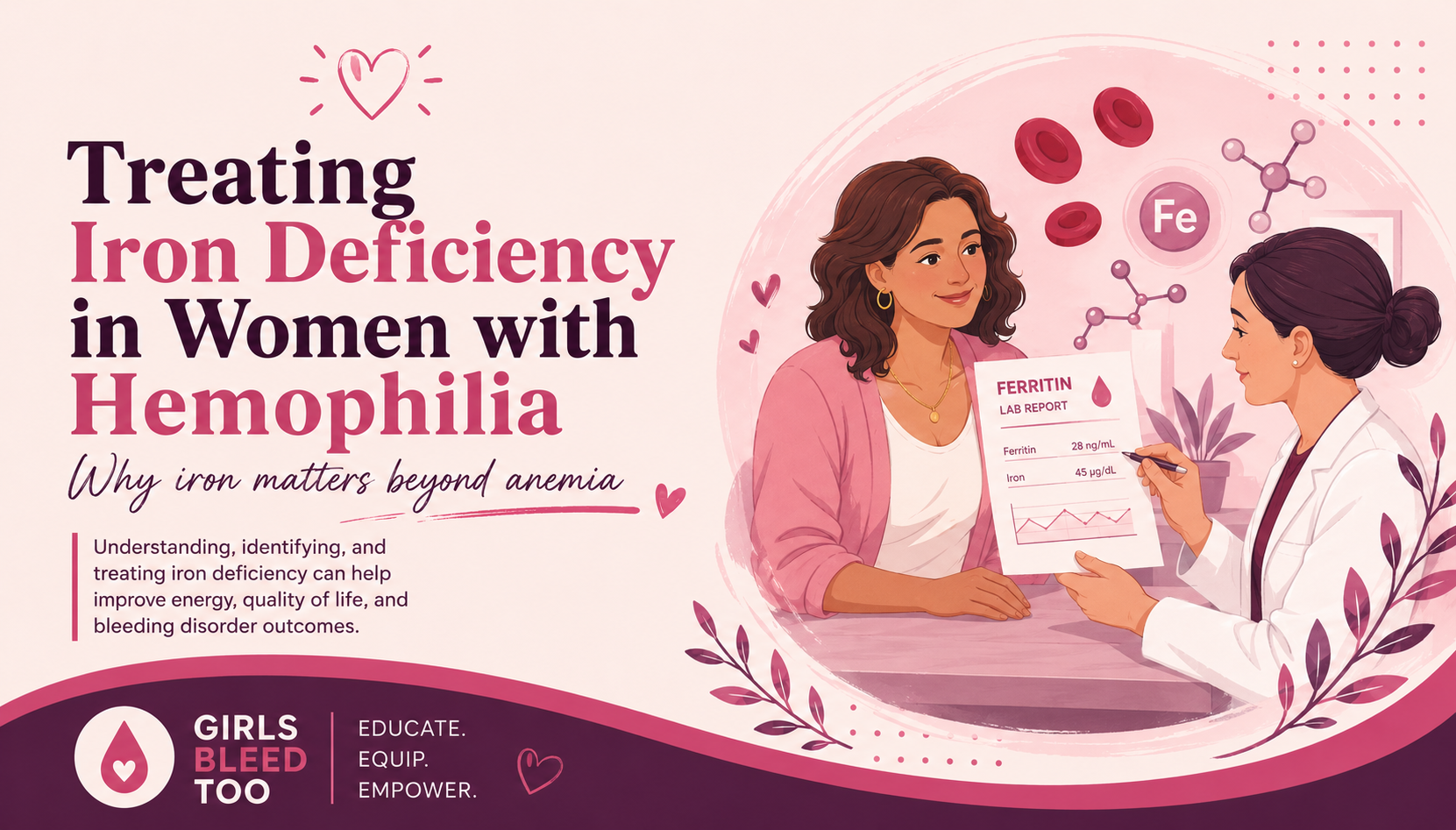
The other half of this is iron. Heavy bleeding month after month drains iron faster than food replaces it, and the symptoms — exhaustion, breathlessness on stairs, brain fog, hair shedding, cold hands, craving ice — get put down to stress or a busy life for years. Iron deficiency can be significant well before a hemoglobin level looks abnormal, which is why the test that matters is ferritin.
Why heavy periods can be a sign of a bleeding disorder
Von Willebrand disease is the most common inherited bleeding disorder, affecting somewhere around 1% of people. It is inherited equally by men and women, but women carry most of the visible burden, because a monthly bleed is the thing that exposes it.
Among women who go to a doctor about chronic heavy menstrual bleeding, studies have found von Willebrand disease in anywhere from 5% to 24% — a wide range, but every figure in it is far above the general population. Looked at from the other direction, more than three-quarters of women with von Willebrand disease report heavy periods. The overlap is not a coincidence, and it is not rare.
And yet the average woman waits years for a diagnosis. Some of that is biology: mild bleeding disorders are genuinely hard to catch. Most of it is not. Heavy periods get treated as a gynecological problem to be managed rather than a bleeding symptom to be investigated, so women get offered the pill, then an IUD, then an ablation, then a hysterectomy — a whole treatment ladder, without anyone once checking whether the blood itself clots properly.
Bleeding disorders are also not only about periods. If you bruise without remembering the knock, get nosebleeds that run past ten minutes, bled more than expected after a wisdom tooth extraction, or hemorrhaged after childbirth, those belong in the same conversation. Bleeding in more than one place is what moves a doctor from thinking gynecology to thinking hematology.
What tests to ask for
You do not need to know the science to ask for the right panel. Ask for these by name:
CBC with platelet count, and ferritin. Ferritin measures your iron stores, and it drops long before hemoglobin does. Ask for the actual number, not just "normal" — many labs flag a ferritin as normal at levels most hematologists would treat.
PT and aPTT. Basic clotting times. Useful to have, but be aware they are frequently normal in mild bleeding disorders, so a normal result here does not close the question.
A von Willebrand panel: VWF antigen, VWF activity, and factor VIII. These need to be ordered together — no single one of them is diagnostic on its own.
Now the part that matters most, and that almost nobody is told: a normal result does not rule it out.
Von Willebrand factor is not a fixed number. It rises with estrogen, stress, exercise, infection, inflammation, and pregnancy — so if you are on hormonal birth control, or you were anxious about the needle, or you had a cold that week, your level can test normal on a day when it usually is not. People with blood type O run about 25% lower at baseline, which cuts the other way. This is why guidelines recommend repeating the test on a separate day, generally at least two weeks apart, and ideally not in the middle of active heavy bleeding.
So if your results come back normal and your bleeding has not changed, the reasonable next question is not "so I'm fine?" It is: given how variable von Willebrand factor is, can we repeat this at a different point in my cycle? That single sentence is often the difference between a diagnosis and another five years.
What to do if your doctor says it's normal
Most women reading this have already had this conversation. Here is what tends to work.
Bring numbers, not adjectives. "Heavy" means something different to every doctor who hears it. "I change a super tampon every hour on my worst two days, I bleed for nine days, and I passed clots the size of a golf ball last month" cannot be waved off the same way. This is the entire reason the tool above prints a page — hand it over rather than trying to remember it under pressure.
Ask for the reasoning, and ask for it in the chart. "What is making you confident this isn't a bleeding disorder?" is a fair, calm question, and asking that it be documented tends to change the temperature of the room. So does: "I'd like it noted that I asked for a von Willebrand panel and we decided against it."
Ask for a referral rather than an argument. You are not trying to win a debate with your gynecologist, who may simply not have been trained on this — awareness of bleeding disorders as a cause of heavy periods is low across obstetrics and gynecology, and that is a known problem in the field, not a personal failing. What you want is a hematologist.
You can go around the problem. In the US, federally supported hemophilia treatment centers exist in every state, many with clinics specifically for women and girls, and a number accept self-referrals. They are staffed by people for whom your symptoms are ordinary rather than surprising. Finding your nearest one is often faster than persuading anyone.
And if you have been dismissed before, that is data too. Tell the next doctor how long this has gone on and how many people have said it was normal. A fifteen-year history of being told nothing is wrong, while the bleeding continues, is itself a clinical finding.
If this sounded familiar…




Always approach conversations with empathy, respect, and an open mind