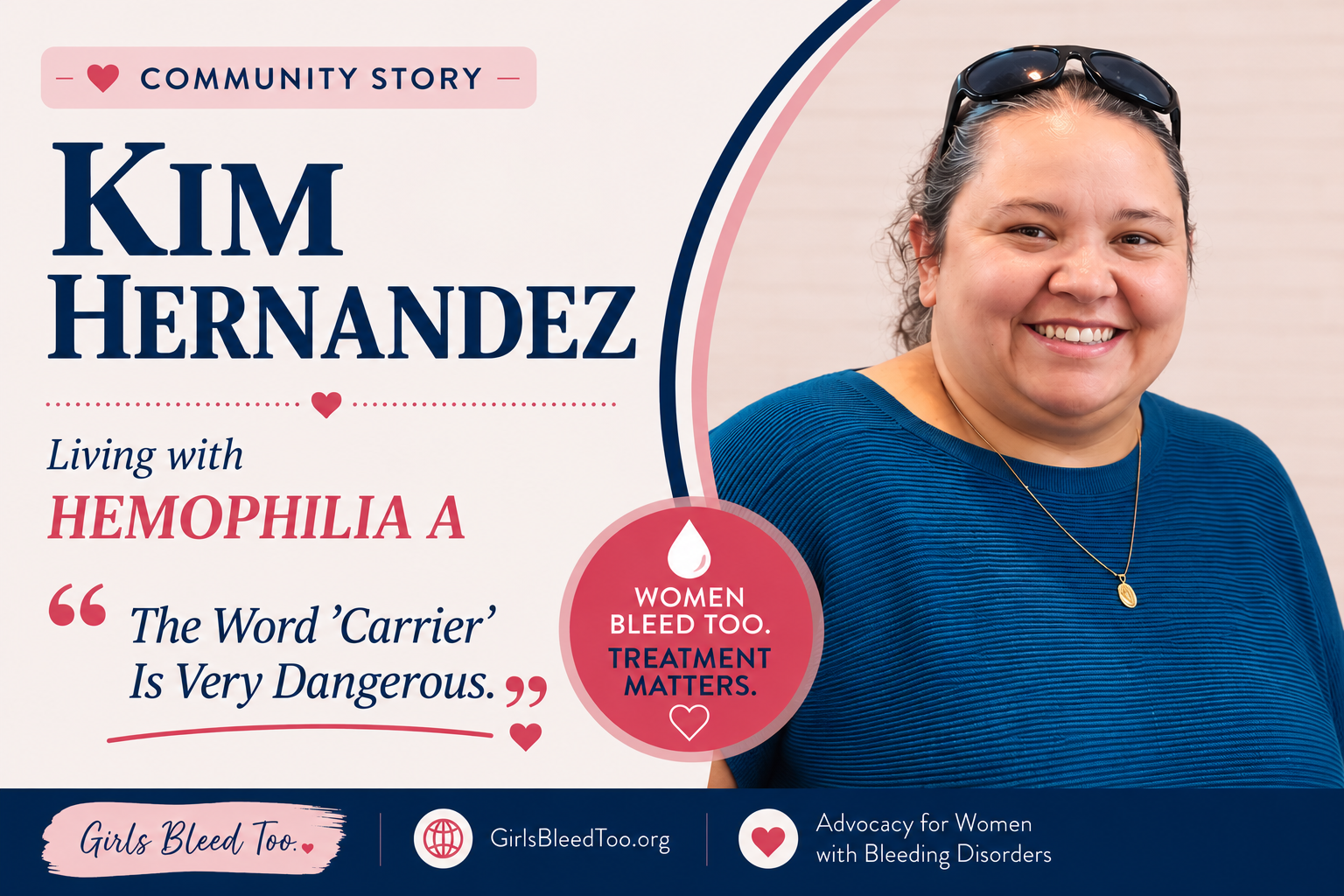
"The Word 'Carrier' Is Very Dangerous": Kim Hernandez's Story
Today, women with an F8 or F9 variant and reduced factor levels may be diagnosed as having hemophilia themselves—not simply described by their genetic ability to pass it on.
Kim Hernandez grew up understanding hemophilia from the outside — her father lived with a severe form of it, and she watched what that meant for his body, his choices, his life. What she didn't fully understand, not until years later, was that the disorder had a hold on her too.
When her sister became pregnant, both women were tested. Kim’s factor level came back at 51% — just one point above the threshold for mild hemophilia. One point. That was enough to shape how the medical system would see her: she was labeled a carrier, not a woman with mild hemophilia.
But her body had been telling a different story for years.
Heavy periods. Joint pain. Bleeding symptoms that had never been given the weight they deserved. Her history was there. Her symptoms were there. But the label was there, too — and “carrier” made it far too easy to dismiss everything else.
“Carrier" is a word that tends to get treated as a footnote — something you pass along, not something you live with. That gap between the label and the lived reality is exactly where Kim's story turns.
Ahead of a routine knee procedure, Kim did everything right. She told her surgical team about her bleeding history. She asked them to loop in a hematologist. It was a reasonable request from someone who knew her own body.
They moved forward without one.
What was supposed to be a minor repair became a medical emergency. A ruptured pseudoaneurysm. An emergency surgery that stretched to twelve hours. Weeks in the hospital, and a recovery that reshaped what her daily life looks like now — including how she moves through the world.
Kim's takeaway from all of it isn't really about the surgery. It's about the word that came before it. "Carrier" sounds passive, almost incidental, like a technicality tucked into a genetics textbook. For Kim, it was the difference between a warning taken seriously and a warning waved off.
That's the pattern so many women in this community recognize instantly, whichever bleeding disorder brought them here: the information was available. It just wasn't believed in time.
Kim's experience is also part of a larger reckoning captured in Dismissed, the documentary that gives voice to women whose bleeding disorder symptoms were minimized and diagnoses overlooked. Her story sits alongside others who know exactly what it costs to not be believed.
Watch Kim's story in "Dismissed" → VIEW
Kim knew her own bleeding history. She warned her medical team. What happened next is exactly why words matter — and why the word “carrier” can be so dangerous.
Girls Bleed Too exists so that women like Kim are believed before something goes wrong, not after.
Read Kim's full interview on Hemophilia News Today → VIEW
Kim's story of being dismissed isn't unique.
Read Connie Montgomery's decades-long fight to be believed, or learn why heavy periods might be more than "just heavy periods."