More Treatment Choices Mean More Homework. Here's Where to Start.

I was diagnosed with hemophilia B and von Willebrand disease at 10. Back then, there was one treatment. You took it or you bled.
That's no longer true. Today the list includes extended half-life factor, non-factor prophylaxis given by injection, rebalancing agents, and gene therapy. Each option comes with tradeoffs: how often you dose, how it's given, what monitoring it needs, and how your bleed plan changes.
That's a win. It's also a job, and most of us were never trained for it.
Why this matters more for women and girls
Many of us spent years being told our bleeding was normal. Some of us still are. When you finally get a diagnosis, the conversation often skips straight to "here's what we'll do."
Shared decision-making means you're part of that conversation. You can't take part fully if you don't know what the options are.
Most clinical trials for these therapies enrolled mostly men and boys. Ask your care team what that means for you: periods, pregnancy, surgery, and how bleeds show up in your body.
Questions to bring to your next appointment
Which options am I eligible for, and why?
How would each one fit my work, travel, and activity level?
What monitoring does each require?
How would my bleed plan change, including for heavy periods?
What would make you recommend switching?
Start here: a free video series
Shared in partnership with CME Outfitters
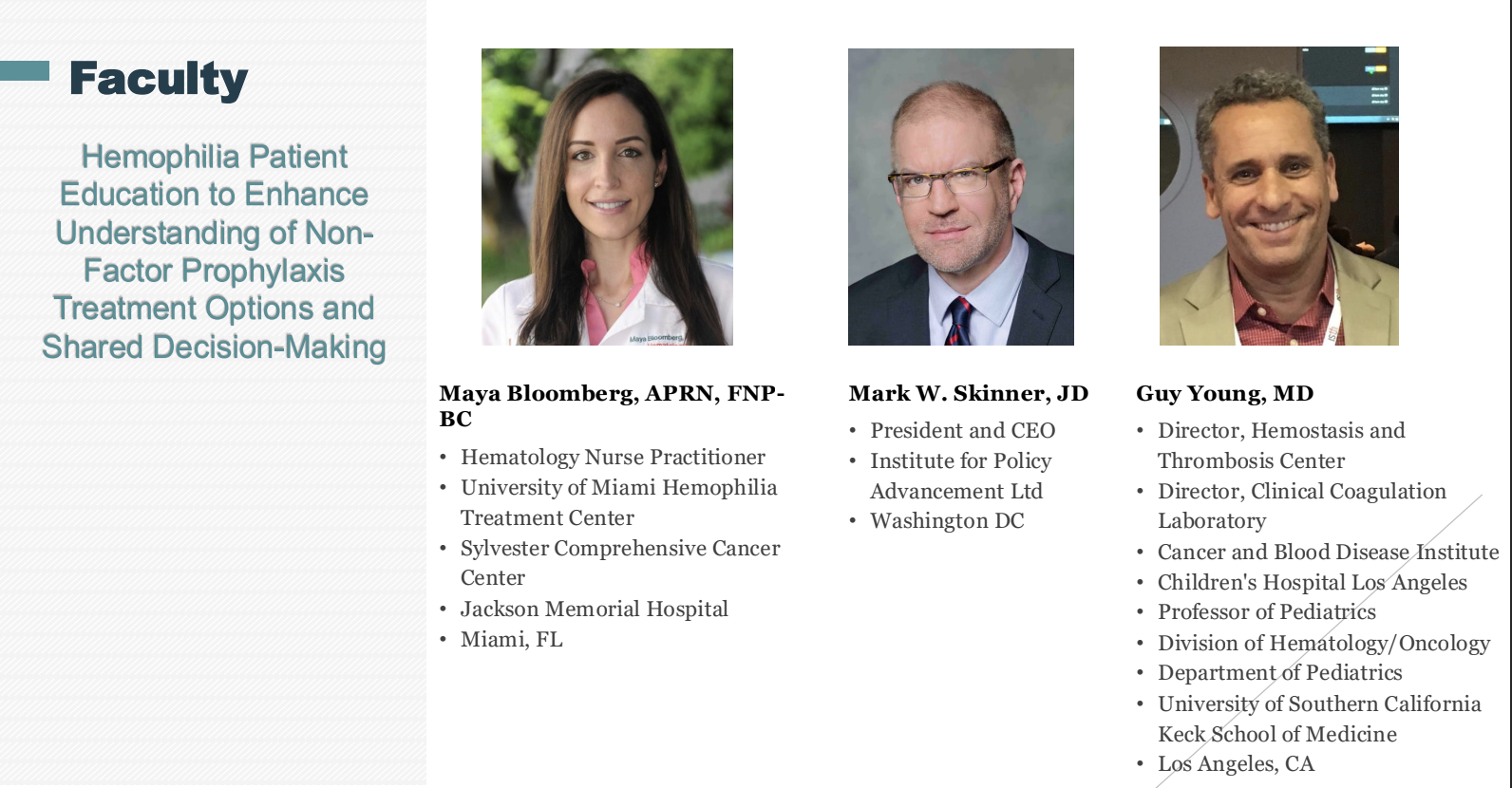
CME Outfitters created a 10-part webisode series on these treatment options, each episode two to five minutes long. Faculty include Maya Bloomberg, APRN, of the University of Miami Hemophilia Treatment Center, along with Guy Young, MD, and Mark Skinner, JD.
Watch the series → CLICK HERE
Read the original column
“Navigating Hemophilia: A Webisode Series on Treatment Options and Overcoming Barriers,” from CME Outfitters, is aimed squarely at explaining new treatment options. It’s free.
It covers non-factor prophylaxis for hemophilia A and B, with and without inhibitors. It takes on gene therapy — not as a headline, but as an option carrying a safety profile and monitoring requirements. And it spells out something I rarely see addressed anywhere: how your bleed plan changes when your prophylaxis changes. What you do for a breakthrough bleed? Or before a procedure? What you tell an emergency room at 2 a.m?
The faculty are Maya Bloomberg, of the University of Miami Hemophilia Treatment Center; Guy Young, MD, of Children’s Hospital Los Angeles; and Mark Skinner, who has spent a career building the case that what patients experience counts as data.
Read the full column on Hemophilia News Today → CLICK HERE
Adapted from "Hemophilia's treatment menu is longer, but patients must put in the work," originally published in Hemophilia News Today on September 18, 2026, as part of Jennifer Lynne's "Hemophilia and Me" column.
Related: Find a provider who gets it →